

6 Vintage Three Stone Engagement Ring Styles from Victorian to Art Deco

Why the Three Stone Format Survives Every Era
Three stone engagement rings appear in every major jewelry era from the Georgian period onward, and that consistency is worth paying attention to. The format is structurally flexible — it accommodates whatever diamond cut and metalwork language each century preferred — while carrying a symbolic weight that never needed updating. Each stone represents a stage: past, present, future. That narrative maps cleanly onto an engagement, which is probably why jewelers kept returning to it regardless of whether the prevailing aesthetic was sentimental gold scrollwork or hard-edged platinum geometry.
But the style is far from uniform across eras. The side stones change. The metal changes. The diamond cut changes dramatically. An Edwardian three stone ring and an Art Deco three stone ring can sit side by side and look like they belong to entirely different design traditions — because in many ways they do. Understanding those differences helps you identify what you’re looking at, what era you’re drawn to, and what to ask for when shopping for an authentic piece.
Below are six distinct styles, organized by era, with the specific details that define each one.
1. Georgian Three Stone Ring (c. 1714–1837): Rose Cuts in Closed-Back Silver-Topped Gold
Georgian three stone rings are the oldest and rarest category you’ll encounter, and they look nothing like what most people picture when they imagine a vintage engagement ring. The diamonds are almost always rose cut — a domed, flat-bottomed cut with triangular facets radiating from the crown — and they sit in closed-back settings, meaning the underside of each stone is enclosed in metal rather than open to light. Behind each stone, jewelers applied a thin metallic foil to amplify brilliance under candlelight, since these rings were designed for evening wear in drawing rooms, not daylight.
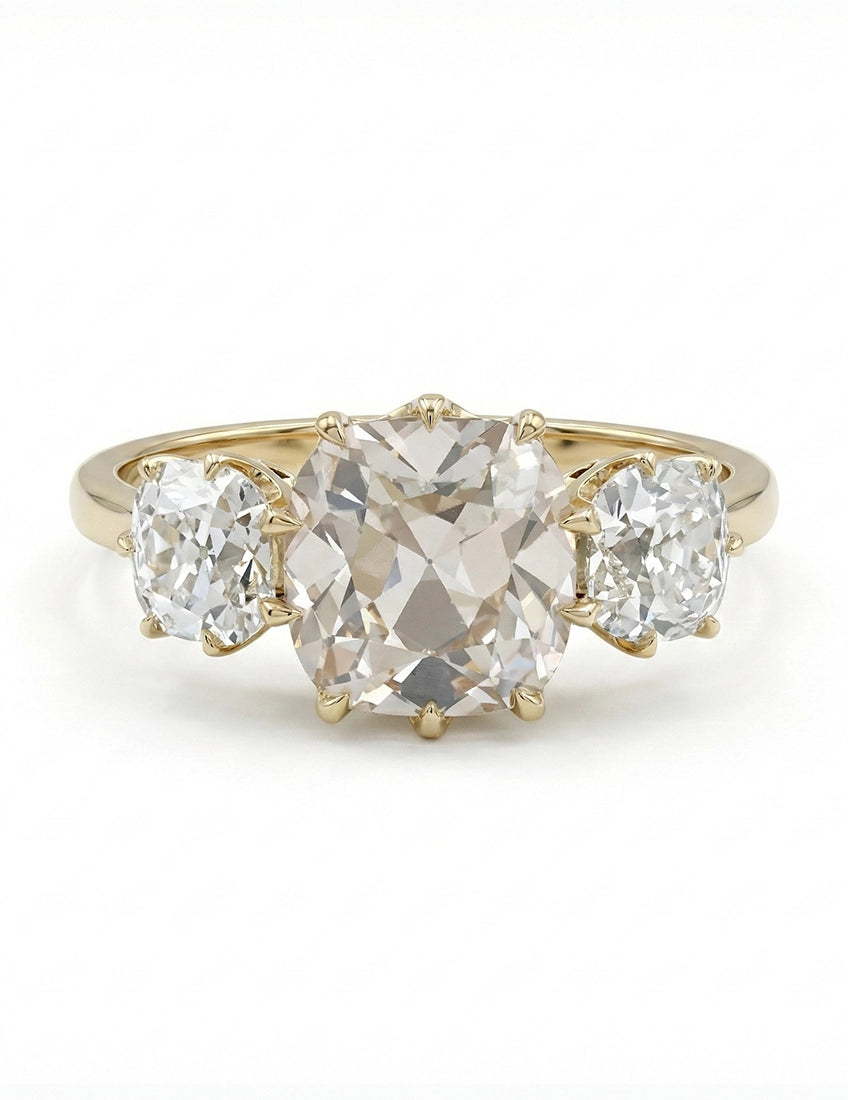
The metal combination is characteristic: silver on top, where the diamonds sit, and yellow gold for the shank and shoulders. Silver enhanced the colorless appearance of the diamonds; gold provided structural durability. You’ll sometimes see intricate cannetille goldwork — fine twisted wire — on the shoulders. Decorative motifs draw from Baroque, Rococo, and Neoclassical sources depending on the decade. Popular diamond cuts for the period included rose cut, old mine cut, and table cut.
Authentic Georgian three stone rings are genuinely rare. Many have had their shanks replaced over the centuries, and the foiled settings are vulnerable to water damage. If you find one in good original condition, it’s a collector’s piece more than an everyday ring — beautiful to own and wear occasionally, but requiring careful handling.
2. Victorian Three Stone Ring (c. 1837–1901): Old Mine Cuts in Yellow and Rose Gold
Victorian three stone rings span a long timeline — Queen Victoria reigned for 64 years — and the style shifted considerably across that period. But the dominant diamond cut throughout most of the era is the Old Mine Cut: a hand-cut stone with a squarish outline, rounded corners, high crown, small table, and a large, open culet visible as a circle when viewed face-up. These stones were cut to perform in gaslight and candlelight, producing a warmer, softer glow than modern brilliant cuts.
The metal is almost always 18k yellow gold, sometimes rose gold (historically called ‘Russian gold,’ made with copper). Silver-topped settings — silver above the gold shank — appear in earlier Victorian pieces to enhance the white appearance of diamonds. The settings tend to feature pronounced prongs, often hand-filed individually, and decorative shoulders with engraving, chased foliate patterns, or granulation. The three stone setting was a recognized hallmark Victorian style alongside the cluster setting.
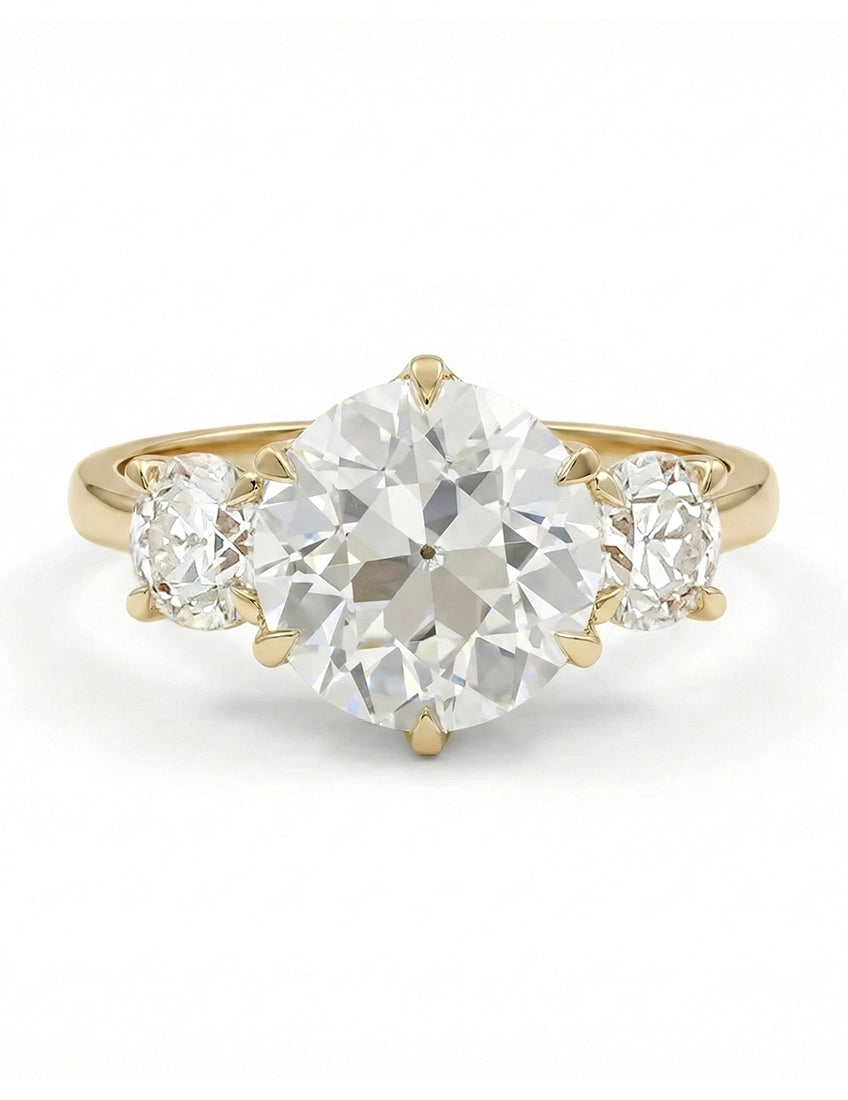
Earlier Victorian three stone rings (pre-1861) lean toward sentimental motifs: serpent shoulders, floral engraving, naturalistic details. Later pieces, from the 1870s onward, become more diamond-forward as South African mines flooded the market with affordable stones. By the 1890s, the Old European Cut begins appearing — a rounder, more symmetrical evolution of the Old Mine Cut — in some late Victorian three stone rings, particularly those with open-back settings.
Colored stone combinations are common in Victorian three stone rings. A center diamond flanked by sapphires, or a ruby flanked by old mine cut diamonds, was entirely normal. The Victorians treated stone choice as a form of communication: specific gems carried assigned meanings.
3. Edwardian Three Stone Ring (c. 1901–1915): Old European Cuts in Platinum Filigree
The shift from Victorian to Edwardian is one of the most dramatic transitions in engagement ring history, and it’s immediately visible in a three stone ring. The yellow gold disappears. The heavy engraved shoulders disappear. What replaces them is platinum — the first era in which platinum settings became standard — and an entirely different visual vocabulary built around delicacy, openwork, and light.
Platinum’s strength allowed jewelers to create filigree frameworks that would collapse in gold: thin strips of metal woven and twisted into lace-like lattices, bow motifs, garlands, and scrolling foliate patterns. The technique is called filigree, and it defines the period. Running along the edges of settings, you’ll typically find milgrain — a row of tiny hand-applied metal beads that add texture and dimension. Both techniques were elevated to new levels by platinum’s malleability.
The diamond cut of choice is the Old European Cut: round, hand-cut, with a small table, high crown, and a characteristic circular culet that appears as a dark dot from above. In a three stone Edwardian ring, all three stones are typically Old European Cuts, set flush into the filigree mounting with small accent diamonds scattered throughout the openwork for added embellishment. The three stone arrangement in this era sometimes runs vertically (north-south) rather than the conventional horizontal line, with the stones stacked along the finger.
Edwardian three stone rings in platinum with Old European Cut diamonds are among the most sought-after vintage styles in 2026. They’re genuinely antique — over 100 years old — and the combination of platinum durability and hand-crafted filigree makes them more wearable than Georgian pieces. Old Gem House carries Old European Cut diamonds sourced specifically for their hand-cut character, the kind that defines authentic Edwardian-era three stone rings.
4. Art Nouveau Three Stone Ring (c. 1890–1910): Organic Forms with Mixed Cuts
Art Nouveau overlaps with both the late Victorian and early Edwardian periods, and three stone rings from this style tend to be the ones that don’t fit neatly into either category. The defining characteristic is naturalistic, organic metalwork: flowing lines, asymmetrical curves, enamel accents, and motifs drawn from insects, flowers, and the female form. Where Edwardian jewelry is symmetrical and architectural, Art Nouveau is sinuous and almost botanical.
Diamond cuts in Art Nouveau three stone rings vary. You’ll find Old Mine Cuts, Old European Cuts, and occasionally rose cuts depending on the date and the maker. The metal is usually gold — yellow or green gold — sometimes with platinum accents on the stone settings. Enamel work, particularly plique-à-jour (translucent enamel without a metal backing), appears in higher-end pieces. Colored stones — sapphires, opals, moonstones, and demantoid garnets — frequently appear as center or side stones.
Authentic Art Nouveau three stone rings are harder to find than Victorian or Edwardian examples, partly because the style was regional (strongest in France, Belgium, and Germany) and partly because the organic metalwork is fragile. When you do find one, the metalwork itself is often the main event — the stones are almost secondary to the flowing, sculptural setting that surrounds them.
5. Art Deco Three Stone Ring (c. 1920–1935): Geometric Platinum with Baguette or Step-Cut Side Stones
Art Deco three stone rings are the polar opposite of Art Nouveau — and that contrast was intentional. The movement emerged as a deliberate rejection of the flowing, organic aesthetics that preceded it. Inspired by modern architecture, Cubism, and the machine age, Art Deco jewelry favors bold geometric patterns, sharp lines, and strict symmetry.
In a three stone Art Deco ring, the side stones are usually baguette cuts (long rectangles), trapezoids, or half-moons — shapes that reinforce the geometric design language of the era. The center stone tends to be an Old European Cut, an Asscher cut, or an emerald cut, all of which have step-cut facets that produce broad flashes of light rather than the scattered brilliance of modern rounds. Early Art Deco (1920–1925) is almost entirely platinum and white diamonds in monochromatic compositions that emphasize line and structure over color. Later Art Deco (1926–1935) introduced bold color — rubies, sapphires, emeralds, and onyx — arranged in high-contrast patterns, often in white gold or yellow gold as platinum became harder to source.
Platinum dominated the early Deco period because its strength allowed jewelers to create the intricate, precise settings the style demanded, and its bright luster enhanced the geometric design. The setting technique known as pavé also evolved during this period, with small accent diamonds used to fill geometric recesses around the three main stones.
Art Deco three stone rings are among the most collectible vintage styles. Their architectural precision means they photograph well and wear dramatically. If you’re drawn to this period, look for consistent symmetry across all three stones, crisp metalwork with no softness or curves, and — in authentic pieces — the characteristic platinum or white gold construction. Old Gem House’s collection of three stone rings includes Art Deco-era examples and custom designs that draw on Deco geometry while incorporating hand-cut antique diamonds.
6. Retro and Mid-Century Three Stone Ring (c. 1935–1955): Bold Gold with Transitional Cuts
The Retro era arrived when World War II cut off platinum supplies for civilian use, forcing jewelry makers back to gold. The result was a dramatic stylistic shift: yellow and rose gold replaced platinum, and the scale of rings grew larger and bolder. Retro three stone rings tend to be substantial and three-dimensional, with sweeping curves, architectural lines softened by curves and etchings, and a deliberate visual weight that distinguished them from the delicate Edwardian work that preceded them.
The diamond cuts in Retro-era three stone rings are typically transitional cuts — stones cut in the period between the Old European Cut and the modern round brilliant, with characteristics of both — or early round brilliant cuts. Baguette side stones carried over from the Art Deco period and remained popular through the 1940s. By the early 1950s (Mid-Century Modern), the design language simplified further: cleaner lines, streamlined silhouettes, and a preference for larger center stones in illusion settings that made the diamond appear bigger than its actual carat weight.
Mid-Century three stone rings from the 1950s often pair a round brilliant center with two matching baguettes or tapered side stones in 14k or 18k yellow gold. The metalwork is polished and smooth rather than engraved or filigree-worked. These rings are probably the most wearable of all the vintage styles — they’re durable, have a lower profile than Edwardian pieces, and the gold construction is straightforward to resize and maintain.
For buyers who want an authentic antique diamond in a more understated setting, Retro and Mid-Century three stone rings offer a practical entry point. The Old Mine Cut diamonds that appear in some Retro-era pieces carry the same hand-cut character as earlier Victorian examples — each stone slightly different from the next, shaped around the individual rough rather than forced into a standardized template.
How to Choose Between These Six Styles
The clearest way to narrow your choice is to start with metal preference, then work backward to era. If you want yellow or rose gold, you’re looking at Victorian, Art Nouveau, or Retro. If you want platinum or white gold, Edwardian and Art Deco are the natural territory. If you want something genuinely rare and museum-quality, Georgian rose cut pieces exist — but they require careful handling and aren’t suited to daily wear.
Diamond cut preference is the second filter. Old Mine Cuts have a squarish outline and a warm, candlelit glow. Old European Cuts are rounder, with a slightly more modern brilliance but still distinctly hand-cut. Baguettes and step cuts read as geometric and architectural. Each cut carries the visual language of its era, and mixing a cut with the wrong setting — an Old Mine Cut in an Art Deco mounting, for example — tends to look incongruous.
Finally, consider wearability. Edwardian filigree is durable in platinum but the openwork can catch on fabric. Art Deco platinum settings are generally sturdy. Victorian yellow gold pieces vary widely in condition. If you’re planning to wear the ring daily, condition and construction matter as much as style.
Authentic vintage three stone engagement rings — across all six of these styles — are genuinely one-of-a-kind. No two Old Mine Cut diamonds cut by hand in the 1880s are identical. That variability is the point. It’s what makes a vintage three stone ring different from anything produced today, regardless of how carefully a modern ring tries to replicate the look.